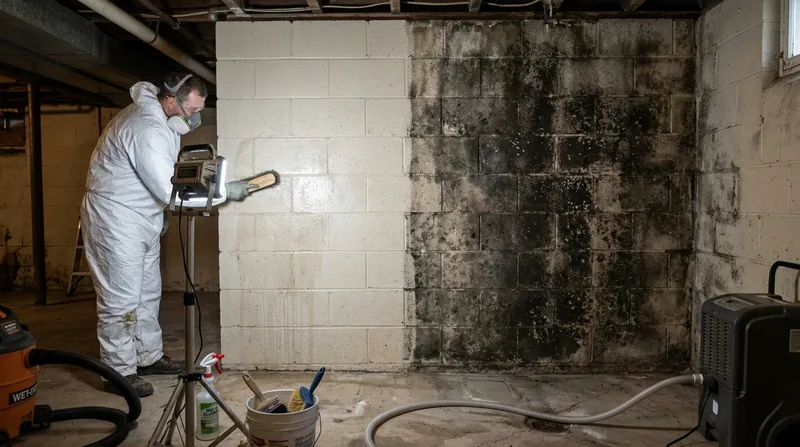




Basement Mold Remediation in Peoria: Fix the Moisture, Not Just the Mold
If you are dealing with Basement Mold Remediation in Peoria, you already know the musty smell and the dark staining on the lower block are symptoms, not the whole story. Peoria sits on windblown loess silt over glacial clay, and that clay drains slowly. In the older bungalows of Downtown, Richwoods and Averyville, stone and brick basement walls wick groundwater all spring. In the Northwoods ranches and the newer poured basements on the city's edges, a failed sump pump or a short discharge line turns a finished room damp within days. We treat the mold, dry the structure, and correct the water path so growth does not come back with the next wet season. Basement waterproofing is the permanent half of the job.
Why Basement Mold Grows So Fast in Peoria's Loess and Clay Soils
Peoria's flats hold water. The loess silt on top takes in spring rain quickly, then the glacial clay below it refuses to pass it on, so the water table rises against footing drains and basement walls. Add humid summers and hard runoff dropping off the West Bluff and Peoria Heights, and basement humidity stays above 60 percent for weeks. Mold needs only a damp surface and still air to colonize drywall paper, joists and stored goods.
- Hydrostatic pressure pushes water through porous block and old brick, feeding mold behind the wall face.
- Snowmelt and Illinois River high water raise the water table into low basements across South Peoria and Bartonville.
- A failed sump pump or clogged check valve leaves the basin overflowing during a summer storm.
- Downspouts that dump at the foundation send roof water straight into the soil beside the wall.
Each of these leaves the same signature: efflorescence, a musty basement smell, and mold growth along the base of the wall or under the stairs.
Key info: In a 1920s Richwoods bungalow with a stone foundation, we often find mold on the back of the drywall and on the sill plate, not just on the visible wall. The moisture source is usually a footing drain that has silted shut, not a crack.
For official guidance on moisture and mold in homes, the EPA mold resources are a solid starting point, and they reinforce the same principle we work by: control the moisture first.
How We Run Basement Mold Remediation in Peoria, Step by Step
We do not fog a basement and call it done. Our process starts with moisture diagnostics because mold returns wherever the water path stays open. We check wall moisture with a pin meter, test the slab and joists, trace the sump discharge, and look for efflorescence and staining that show where water enters. Then we build containment and remove affected material before treating surfaces.
- We inspect the basement and foundation, map moisture readings, and identify the water source.
- We set up containment with poly sheeting and negative air pressure to keep spores out of the rest of the house.
- We remove mold-damaged drywall, insulation and trim, bagging it for disposal.
- We clean and treat structural surfaces with an antimicrobial product and HEPA-vacuum the space.
- We correct the moisture path with drainage, sealing or dehumidification, depending on what the readings show.
- We verify dryness with a final moisture check before we pull containment.
The moisture fix is what separates remediation from a cleaning. In most Peoria basements that means an interior drain tile system or a sump upgrade, and sometimes both.
Key info: A Pekin ranch had mold on the lower two feet of drywall after every spring thaw. The sump pump ran, but the discharge line froze and split in January. We replaced the line, added a battery backup sump pump, and the wall stayed dry through the next wet season.
Remediation Methods We Use in Peoria Basements
Not every mold job needs the same tools. We match the method to the moisture reading and the wall type, whether it is early poured concrete in North Peoria or brick and stone in the older neighborhoods. The table below shows the approaches we use most and when each one fits.
| Approach | Description | Best for |
|---|---|---|
| Surface treatment and HEPA cleaning | Antimicrobial treatment on joists, block and framing after removal of damaged material. | Light surface growth on structural wood and masonry. |
| Containment and material removal | Poly containment, negative air, bagging and disposal of mold-damaged drywall and insulation. | Finished basements with mold behind drywall or under carpet. |
| Drainage correction | Interior drain tile, sump replacement or discharge repair to stop recurring water. | Basements that flood or seep after spring rain and snowmelt. |
| Wall sealing and vapor control | Basement wall sealing and vapor barrier to reduce moisture migration through block and brick. | Damp walls with efflorescence but no standing water. |
| Dehumidification | Sized dehumidifier and ventilation to hold basement humidity below the mold threshold. | Humid summers and basements with no active leak. |
We choose the lightest method that solves the moisture problem, and we tell you plainly when a simple wall sealing job is enough.
Basement Mold Remediation Cost in Peoria: What to Expect
Most basement mold remediation in Peoria starts around From $1,500 for a contained area with surface treatment and a moisture correction. That figure covers a defined scope: containment, removal of affected material, treatment, and a plan for the water source. Larger finished basements with mold behind drywall, or jobs that need drain tile and a sump replacement, run higher.
Several factors move the number. Square footage of affected area matters most, followed by whether the wall is block, brick or poured concrete, and whether the moisture fix is sealing, drainage or a sump upgrade. Access is a real cost in older Peoria homes with narrow stairs and low headroom, and emergency calls after a storm carry a premium. We recommend getting two or three written estimates with the same scope so you can compare them fairly. Our full pricing overview breaks down the ranges by job type.
Choosing a Basement Mold Remediation Contractor Near Me in Peoria
Mold work is unlicensed in many states, so the contractor's insurance and references carry the weight. Ask for a certificate of insurance showing general liability and workers' compensation, and confirm the crew is covered on your property. Get at least three estimates with itemized scopes, because a low bid that skips containment or moisture correction is not a comparable price. Ask for local references from Peoria or East Peoria basements similar to yours, and call them.
Permits matter when the job touches structural repair or alters drainage or the sump discharge connection. Rules vary by jurisdiction, so verify with the City of Peoria building department before work starts. A contractor who hesitates to discuss permits is a warning sign. When you are ready, contact us for a free basement inspection and we will tell you what the moisture readings show.
Basement Mold Remediation in Peoria: Pricing Guide
| Service | Price | Details |
|---|---|---|
| Contained surface remediation | Starting at $1,500 | Includes containment, HEPA cleaning, antimicrobial treatment and a written moisture plan for a defined area. |
| Finished basement with wall cavity mold | Starting at $3,200 | Covers removal of mold-damaged drywall and insulation, containment and treatment, priced by affected square footage. |
| Remediation plus drainage correction | On estimate | Needs an on-site look because interior drain tile, sump work and wall sealing vary by foundation type and access. |
| Emergency response after a storm or flood | On estimate | Priced after hours and on urgency, with extraction and drying equipment included in the scope. |
| Travel | Included | In Peoria and surrounding areas, with no separate call-out or mileage fee added to the estimate. |
| Estimate | Free | Response within 24h at (309) 322-9378, with no obligation to book the work. |
Indicative pricing, the exact cost depends on square footage, finish, and site access. Free personalized estimate within 24h at (309) 322-9378.


