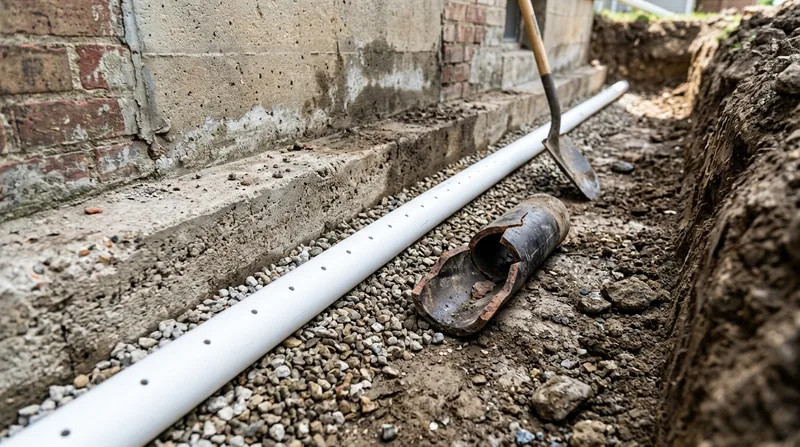




Drain Tile Repair & Replacement in Peoria
Peoria sits on windblown loess silt over glacial clay, and that soil drains slowly. In wet springs the water table rises, and in the older neighborhoods like Downtown, Richwoods and Averyville, many basements still depend on original clay tile footing drains laid more than eighty years ago. When those tiles collapse, clog with roots, or fill with silt, water backs up against the footing and finds its way inside. Drain Tile Repair & Replacement in Peoria is the work of restoring that buried drainage so groundwater moves away from the foundation instead of into your basement. We camera-inspect the line, excavate only where needed, and replace failed tile with modern PVC. If you are seeing water after rain, start with a free basement inspection so we can confirm whether the drain tile is the source.
Why Drain Tile Repair Matters in Peoria's Older Basements
Most Peoria homes built before 1940 have stone, brick or early poured foundations, and the footing drain was often clay tile laid in a gravel trench with no filter fabric. Over decades, silt from the loess soil washes in, tree roots from maples and elms find the joints, and sections shift or crush under freeze-thaw movement. The result is a drain that looks fine on the surface but no longer carries water. On the West Bluff and in Peoria Heights, steep ground sends runoff down fast, and a failed footing drain shows up as a wet basement within hours of a hard summer storm.
- Original clay tile lines collapse at the joints and stop flowing after decades underground.
- Tree roots enter through open joints and gradually block the pipe diameter.
- Silt from glacial clay soil settles in low spots and hardens into a plug.
- Failed drain tile lets hydrostatic pressure build against the footing and basement wall.
- Downspouts and grading that dump water near the wall overload a drain that is already compromised.
When the footing drain is gone, no amount of patching inside will stop water from returning, so identifying the failed line first saves money and repeat work.
Key info: A 1920s bungalow in Averyville with a stone foundation and original clay tile is the classic Peoria drain tile failure. The basement stays dry in winter, then weeps at the cove joint every March when snowmelt and spring rain raise the water table.
For questions about permits and drainage connections, the City of Peoria Community Development Department is the authority to check before any work begins: City of Peoria Community Development.
How We Repair and Replace Drain Tile in Peoria
We start by finding out what is actually wrong with the existing line. A camera inspection tells us whether the tile is crushed, root-bound, silted or simply disconnected at a joint. From there we choose targeted repair or full replacement, and we keep excavation as small as the job allows. On homes in North Peoria and South Peoria with partly finished basements, we plan the work around finished walls and floors so the disruption stays contained.
- We camera-inspect the existing drain tile and mark the depth and location of the failure.
- We excavate a targeted trench to the footing at the failed section, not the whole perimeter.
- We remove collapsed clay tile, roots and silt, then check the gravel bed and filter fabric.
- We install new PVC drain tile with proper slope and cleanouts, wrapped in filter fabric and gravel.
- We tie the line into the sump basin or discharge point and test flow before backfilling.
- We restore grading and downspout extensions so surface water stops loading the new drain.
Every replacement ends with a flow test, because a drain that is not verified under real water load is not finished.
Key info: A ranch in Northwoods had a sump pump running constantly after every storm. The camera showed a crushed clay tile section under a patio slab. We replaced that run with PVC and tied it to the existing basin, and the pump cycling dropped back to normal. If the pump itself is the weak point, see sump pump installation and replacement.
Drain Tile Repair Methods We Use in Peoria
The right method depends on where the failure sits, how deep the footing is, and whether the line runs under a slab, a driveway or open yard. We match the approach to the site rather than forcing one system onto every basement.
| Approach | Description | Best for |
|---|---|---|
| Targeted spot repair | Excavate and replace one failed section of tile, leaving sound pipe in place. | Isolated collapse or root intrusion on an otherwise flowing line. |
| Full exterior footing drain replacement | Replace the perimeter clay tile with new PVC, gravel and filter fabric. | Long runs of crushed or silted tile around an older foundation. |
| Interior perimeter drain tie-in | Install an interior drain along the footing inside the basement and connect to the sump. | When exterior excavation is impractical or the wall is already under pressure. |
| Drain tile cleaning and root cutting | Jet or rod the line, cut roots and restore flow where the pipe is still structurally sound. | Silt or root blockage without collapsed sections. |
| Sump and discharge upgrade | New basin, pump, check valve and discharge line to handle the restored drain flow. | Drain tile that now carries more water than the old pump can move. |
If the drain is sound but the wall still seeps, the better answer may be an interior drain tile system that manages water at the cove joint instead of chasing it outside.
Drain Tile Repair & Replacement Cost in Peoria: What to Expect
Most drain tile work in Peoria starts at $750 for a targeted spot repair, and a full perimeter replacement runs higher depending on length and access. The biggest cost drivers are how much tile has to come out, how deep the footing sits, and whether the line runs under a slab, driveway or established landscaping. A line under a finished patio costs more to reach than one in open yard. Homes on the bluffs often need more careful shoring because the grade drops fast.
We recommend getting two or three estimates and asking each contractor whether they will camera the line first. A quote without an inspection is a guess. For a fuller breakdown of what we charge, see our pricing overview.
Drain Tile Repair & Replacement Near Me: Hiring a Contractor Near Peoria
Hiring the right contractor matters more than the lowest number. Ask for proof of licensing and insurance, and confirm the certificate is current. Get at least two or three written estimates that describe the scope in plain terms, including whether camera inspection is part of the job. Ask for local references from Peoria, East Peoria or Pekin and call them. Confirm who pulls any required permit, since work that alters drainage or the sanitary connection of a sump discharge often needs one, and rules vary by jurisdiction. If your home is in a historic district or under an HOA, check those requirements before excavation starts.
To schedule an inspection or ask a question, reach us through our contact page or call (309) 322-9378.
Drain Tile Repair & Replacement in Peoria: Pricing Guide
| Service | Price | Details |
|---|---|---|
| Targeted spot repair | Starting at $750 | Includes camera inspection, targeted excavation and replacement of one failed tile section. |
| Drain tile cleaning and root cutting | Starting at $450 | Includes jetting or rodding the line and cutting roots where the pipe is still sound. |
| Full perimeter footing drain replacement | Starting at $3,500 | Includes new PVC, gravel and filter fabric around the foundation, price moves with run length. |
| Interior perimeter drain tie-in | On estimate | Needs an on-site look to confirm footing depth, wall condition and sump location. |
| Travel | Included | In Peoria and surrounding areas, no separate call-out or mileage fee. |
| Estimate | Free | Response within 24h at (309) 322-9378, no obligation to book. |
Indicative pricing, the exact cost depends on square footage, finish, and site access. Free personalized estimate within 24h at (309) 322-9378.


